Reflex action working model – Step by step guide
What happens when your hand accidentally touches a hot pan? You pull it back instantly. Ever stepped accidentally on a pointed stone?
If Seema pokes a pin on Meena’s finger, Meena immediately moves her hand away. This quick, automatic response — happening in a matter of milliseconds — is called reflex action.
What is reflex action?
Reflex action is an immediate, involuntary and unconscious response of the body to a sudden stimulus.
It happens without the involvement of the brain because the reaction must be extremely fast. Instead, the spinal cord handles the processing to protect the body from harm.
Reflex arc pathway
Let’s understand the reflex arc with a simple example:
- When you touch a hot object, your skin acts as the receptor and senses the danger.
- Sensory neurons carry this signal to the spinal cord.
- The relay neuron inside the spinal cord processes the information.
- A quick response is generated and sent through motor neurons.
- The signal reaches your muscles, causing you to instantly take your hand away.
Is the brain involved in reflex action?
Not directly. As the reflected action has to be immediate, all the processing happens in the spinal cord. Later on, the spinal cord informs the brain about whatever happened in the body so that the brain can learn and further actions can be taken.
That’s all about the biology behind the reflex action. Now, let’s understand reflex action by making a working model. You can make this model by using Havi robotics kits, Craft materials and free downloadable-printable templates.
Reflex action model – The making
Things you need to make reflex arc model
Elements
Power
Motor
IR pair
LED
Accessories
Geared motor
LED cable
Power bank with USB cable
3 pin cable
Craft material
Project templates(Download now)
Card board
Card paper
Glue gun
Fevicol
Cellotape
Double sided tape
Cutter/Scissor
Wheel grip
Skewer stick
You get the electronics components and accessories from any of the following havi elements kits
1. DIY Robotics Starter Kit
2. DIY Robotic Car Kit
Reflex action working model – step by step guide
Before jumping directly to step-by-step guide, watch the quick how to make video of the reflex action model.
Now, let’s move ahead with the step-by-step image guide on how to make a reflex arc model.
Step 1
Download the project templates and take a printout on three A4 sheets.
Color prints are recommended.
Step 2
Cut the body-part templates from the printouts.

Take the parts containing the spinal cord and head, align the nerve lines, overlap them, and join them using tape to form a human body shape.

Step 3
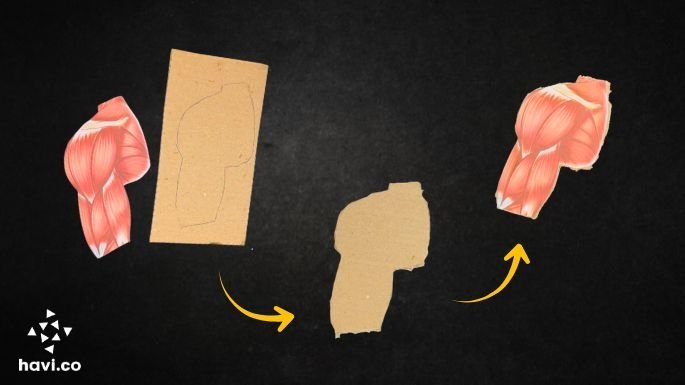
Place the human body template over cardboard.
Trace the outline using a pencil, cut the cardboard using a cutter, and paste the paper template on it.


Step 4
You now have two hand templates — one showing muscles and the other showing fingers.
Repeat Step 3 for both, but use cardboard for the muscle part and card paper for the fingers part.

Step 5
Attach the muscle hand part onto the main body.

Make a small hole at the bottom of the hand muscle and fix the geared motor behind the cardboard using a glue gun.
Ensure the motor shaft faces outward.
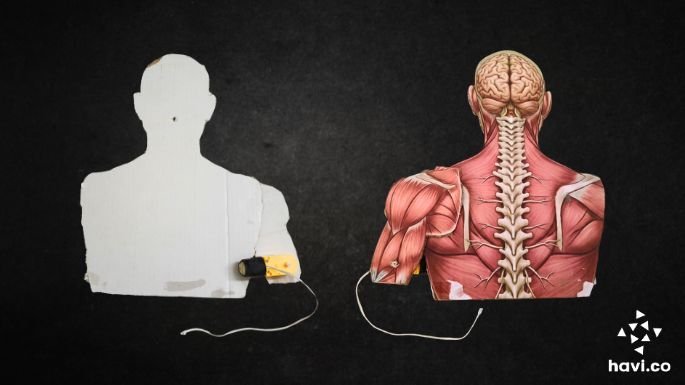
Adult supervision is recommended for young kids while using glue-gun.

Step 6
Make a hole at the corner of the moving hand part (fingers).
Stick a skewer to the back for balance.
Attach the wheel grip to the skewer using a glue gun.
Ensure the wheel grip hole is aligned with the hand hole.

Now fix the wheel grip to the motor shaft.

Step 7
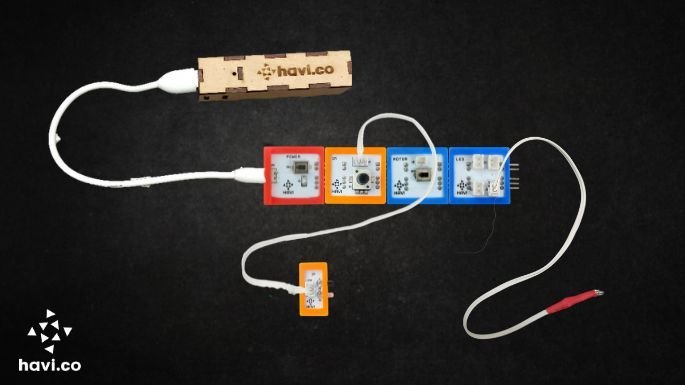
Snap the circuit: Power + IR + Motor + LED. Connect both the IRs using a 3-pin cable. Connect LED Cable with the LED Element.
Step 8
Stick the small IR at the edge of the hand as shown in the image.

Make a hole near the spinal cord area of the template and pass the LED cable through it. The model is almost ready.
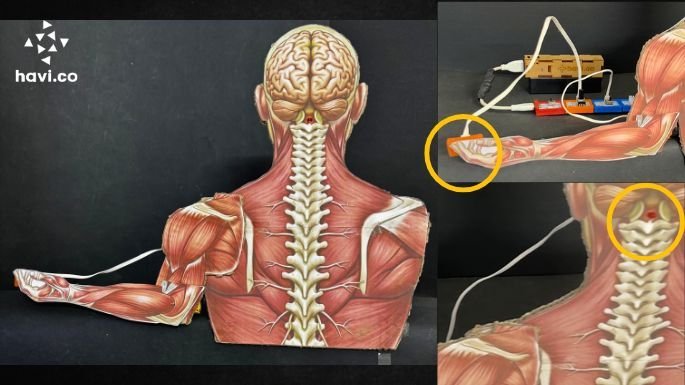
Step 9
Connect the geared motor with the Motor Element. Keep the setup ready as shown in the image.

Your reflex action working model is ready now. Watch the following working video.
How does reflex action model works?
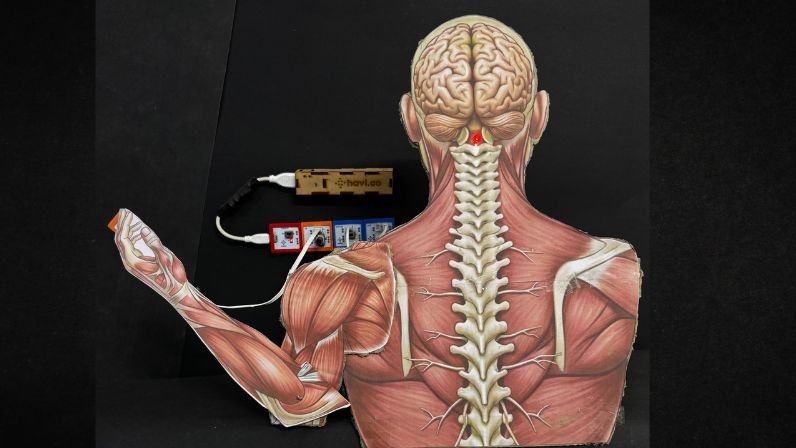
Using the Havi robotics kit and the printable template, this model demonstrates how reflex action happens inside the human body.
- The IR sensor acts as the sensory receptor, detecting fire flame here.
- The signal flows from Power → IR → Motor → LED Element, just like impulses flow in neurons.
- When the IR detects a stimulus, it sends a YES signal forward.
- The Motor Element, representing the motor neuron, activates the geared motor.
- This rotates the attached hand template, showing how your real hand instantly pulls away.
- The LED Element represents the immediate response inside the spinal cord. As soon as the LED receives YES, it glows, showing that processing happens in the spinal cord first.
Thus, just like in our body, the model shows an immediate action without involving the brain initially — perfectly demonstrating a reflex action.
Isn’t this a simple and exciting way to understand reflex action and create a working biology model for science exhibitions?
Teachers and parents — the next time you want to explain reflex action to students, use this working model.
Students will not only enjoy making it but will also remember the concept for life.