
Yelling at Children: The Complete Scientific Guide to Causes, Consequences, Alternatives, & Repair


Akshata has asked her child to wear his shoes.
Once, Twice….Three times……Five times.
The shoes are still not on.
Instead, your child is building a fort with sofa cushions. Akshata is already late. Breakfast dishes are still on the table, lunch is not even half-way, home cleaning robot is out of service and her phone is ringing.
And then it happens.
“CAN YOU PLEASE JUST PUT ON YOUR SHOES?!”
Silence.
The shoes are suddenly on.
Mission accomplished.
Or is it?
Most parents have been there. Many teachers have too.
In fact, if you have never lost your temper with a child, there is a good chance you have either achieved enlightenment or have not spent much time around children.
This article is not about blaming parents, nor is it about pretending children are easy. And it is certainly not about telling exhausted adults to simply “stay calm.”
Instead, this guide explores a deeper question:
Why do caring, loving adults yell at children, even when they don’t want to?
To answer that question, we’ll look at:
- The science of anger
- What happens inside a child’s brain when they are yelled at
- Why yelling sometimes seems to work
- Why it often creates bigger problems later
- What to do instead
- How to repair the relationship after losing your temper
- How to stop getting stuck in the yelling cycle
Whether you are a parent, teacher, caregiver, coach, or grandparent, this guide is for you.
Let’s begin.
Part 1: Understanding yelling
What Is Yelling?
At first glance, yelling seems easy to define.
It’s talking loudly.
But not all loud voices are the same.
Imagine these situations:
Situation 1
A child is running toward a busy road.
You shout:
“STOP!”
That is not harmful yelling.
That is safety communication.
Your brain is trying to protect a child from immediate danger.
Situation 2
A teacher says firmly:
“Everyone, please put your books away.”
The voice is strong and clear.
Not harmful.
Situation 3
A parent says:
“How many times do I have to tell you? Why do you never listen?”
Now something different is happening.
The goal is no longer simply communication.
The voice carries frustration, anger, threat, shame, or loss of emotional control.
That is the type of yelling we are discussing in this article.
A Quick Reflection
Think about the last time you yelled at your child.
What were you really trying to communicate?
- A safety warning?
- A request?
- Frustration?
- Exhaustion?
- Feeling ignored?
Often the words and the real message are not the same.
Part 2: Why do parents yell at children?
Many people assume yelling comes from anger.
But anger is usually only the visible part.
Underneath anger, there is often something else.
What parents say
Parents often say:
- “My child doesn’t listen.”
- “I’ve asked ten times.”
- “Nothing else works.”
- “I was at the end of my patience.”
These are real experiences. But let’s look deeper.
What is really happening?
Very often, yelling is the result of accumulated stress. Not just a single big problem but many small ones together.
Imagine a bucket. With every challenge, add a glass of water into it.
- Poor sleep
- Work pressure
- Financial worries
- Family responsibilities
- Housework
- Constant interruptions
- Child behaviour challenges
Eventually the bucket overflows and the child’s behaviour becomes the final drop.
Many parents are not yelling because they are bad parents.
They are yelling because they are overwhelmed humans.
A quick reflection
Think about your most recent yelling incident.
Why did you yell? Tick mark whichever applies.
Most parents check several boxes.
That tells us something important:
The solution is not simply “be more patient.”
The solution often involves understanding what is happening inside us.
Why do we get angry and start yelling?
To answer this question, we need to meet a small almond-shaped structure inside the brain called the amygdala.
Don’t worry. I am not going to stretch the biology much. 🙂
The amygdala acts like the brain’s alarm system. When the amygdala detects a threat, it prepares the body for action.
“Something feels wrong. Pay attention.”
This system evolved to help humans survive predators.
Unfortunately, modern brains sometimes react to children’s behaviour as if it were a tiger. (Yes Kiran, I know what you are thinking, “Mine really are tigers”, right?)
Your child ignores your request.
Your brain interprets: “Something is wrong.”
Your child talks back.
Your brain interprets: “Threat.”
You are running late.
Your brain interprets: “Danger.”
The amygdala becomes highly active.
Stress hormones increase.
Heart rate rises.
Muscles tense.
And something important happens.
The thinking part of the brain becomes less effective.
Psychologist Daniel Goleman famously called this an “amygdala hijack.”
In simple terms:
The emotional brain temporarily takes control.
Creative pause
Imagine trying to solve a math problem while a fire alarm is ringing next to your head.
Difficult, right?
That is what emotional flooding feels like.
Why don’t children listen?
This may be the most asked parenting question in history.
Parents everywhere wonder:
“Why doesn’t my child listen?”
Let’s begin with a surprising truth.
Children are not designed to behave like adults. Their brains are still under construction.
Literally.
The prefrontal cortex—the part responsible for planning, impulse control, decision-making, and self-regulation—continues developing well into early adulthood.
Children often know what they should do.
They simply struggle to do it consistently.
That difference matters.
Example
Your child knows: “I should put away my toys.”
But at that moment they are:
- Excited
- Distracted
- Curious
- Emotional
- Focused on play
The knowledge exists.
The self-control is still developing.
What children hear
Parents often say: “Please clean your room.”
What children hear:
“I’m leaving my game.”
“Something more interesting is ending.”
“My fun is about to stop.”
This does not make children bad. It makes them human.
Adults struggle with interruptions too. Imagine somebody asking you to stop watching your favourite movie halfway through. You would not be delighted either.
Another quick reflection
Think of a task you often delay:
- Exercise?
- Taxes?
- Laundry?
- Email?
You know it needs to be done. Yet you still postpone it. Now imagine having a brain that is still developing. And children’s behaviour becomes a little easier to understand.
Why yelling feels like it works?
If yelling is problematic, why do so many people keep doing it?
Because sometimes it works. At least in the short term.
The shoes go on.
The homework gets opened.
The classroom becomes quiet.
Immediate compliance can feel effective.
But there is a hidden problem.
The child may be responding to fear, not understanding. They follow to avoid punishment and discomfort and not because they have learned to be disciplined.
Psychologist Dr. Ross Greene often reminds adults:
“Kids do well if they can.”
The goal should not be obedience. The goal is helping children develop the skills they need to succeed.
Fear can create compliance but it rarely teaches the skills.
The yelling trap
Yelling works quickly. Self-discipline comes slowly.
This creates a trap.
Parents see: Yelling → Immediate result
So they use it again.
But over time they often experience: More resistance, more arguments and more emotional distance.
And that’s where many families get stuck.
Part 3: What happens when children are yelled at?
What happens to a child’s brain when they are yelled at?
Let’s return to the fire alarm analogy.
Imagine you are trying to solve a puzzle. Suddenly a loud alarm goes off. Your body becomes alert. Your heart beats faster. You stop thinking about the puzzle and start thinking about the alarm.
Something similar happens when children experience yelling.
The brain shifts from:
Learning Mode
to
Survival Mode
Neuroscientists have found that strong emotional stress activates the amygdala, the brain’s threat detection system.
When that happens:
- Stress hormones increase
- Attention narrows
- Working memory decreases
- Reasoning becomes harder
- Emotional regulation becomes harder
Adults yell because they want children to:
- Think more clearly
- Make better decisions
- Learn from mistakes
But what happens is the opposite. Eventually the brain becomes less capable of doing those things.
A quick experience
Try counting a bundle of mixed denomination currency notes while somebody stands beside you shouting criticism. Not easy.
Children experience similar. The louder the threat feels, the less space there is for learning.
Short-Term effects of yelling
Children react differently.
Some become quiet.
Some cry.
Some argue.
Some shut down.
Some appear unaffected but carry the feelings inside.
Common short-term effects include:
Fear
The child becomes focused on avoiding further conflict.
Shame
Instead of thinking: “I made a mistake.”, they may think: “I am the mistake.”
Anger
Some children absorb anger. Others return it.
Withdrawal
The child stops sharing thoughts and feelings.
Reduced Learning
The original lesson often gets lost. The child remembers the yelling more than the message.
Creative pause
Think back to your own childhood.
Can you remember a time an adult yelled at you?
What do you remember most?
The lesson?
Or the feeling?
Most adults remember the feeling.
Long term effects of frequent yelling
Every parent raises their voice occasionally.
This section is not about occasional mistakes.
It is about repeated patterns.
Researchers have linked frequent harsh verbal discipline with higher levels of:
- Anxiety
- Aggression
- Depression
- Emotional regulation difficulties
- Lower self-esteem
- Relationship difficulties
Why?
Because children learn about relationships from relationships.
If conflict consistently sounds like yelling, they may learn:
- Yelling is how people solve problems.
- Anger equals power.
- Mistakes lead to humiliation.
- Emotions are unsafe.
Of course, every child is different.
Not every child will experience the same outcomes.
But repeated exposure matters.
How yelling affects the parent-child relationship
Relationships are built through thousands of interactions.
A single argument rarely damages a healthy relationship.
Repeated emotional disconnection can.
Imagine trust as a piggy bank.
Every positive interaction adds a coin.
- Playing together
- Listening
- Encouraging
- Laughing
- Helping
Yelling withdraws coins.
A healthy relationship can tolerate withdrawals.
But if withdrawals happen too often, the account becomes depleted.
Children may begin to:
- Hide mistakes
- Avoid conversations
- Stop asking for help
- Become defensive
And parents may start believing:
“My child only listens when I yell.”
Both sides become trapped.
How yelling affects parents
Parents too suffer and this is rarely discussed. After yelling, many adults experience:
- Guilt
- Regret
- Shame
- Exhaustion
- Self-doubt
Have you ever thought:
“I sound just like my parents.”
or
“I promised myself I wouldn’t do that.”
Many parents carry those feelings.
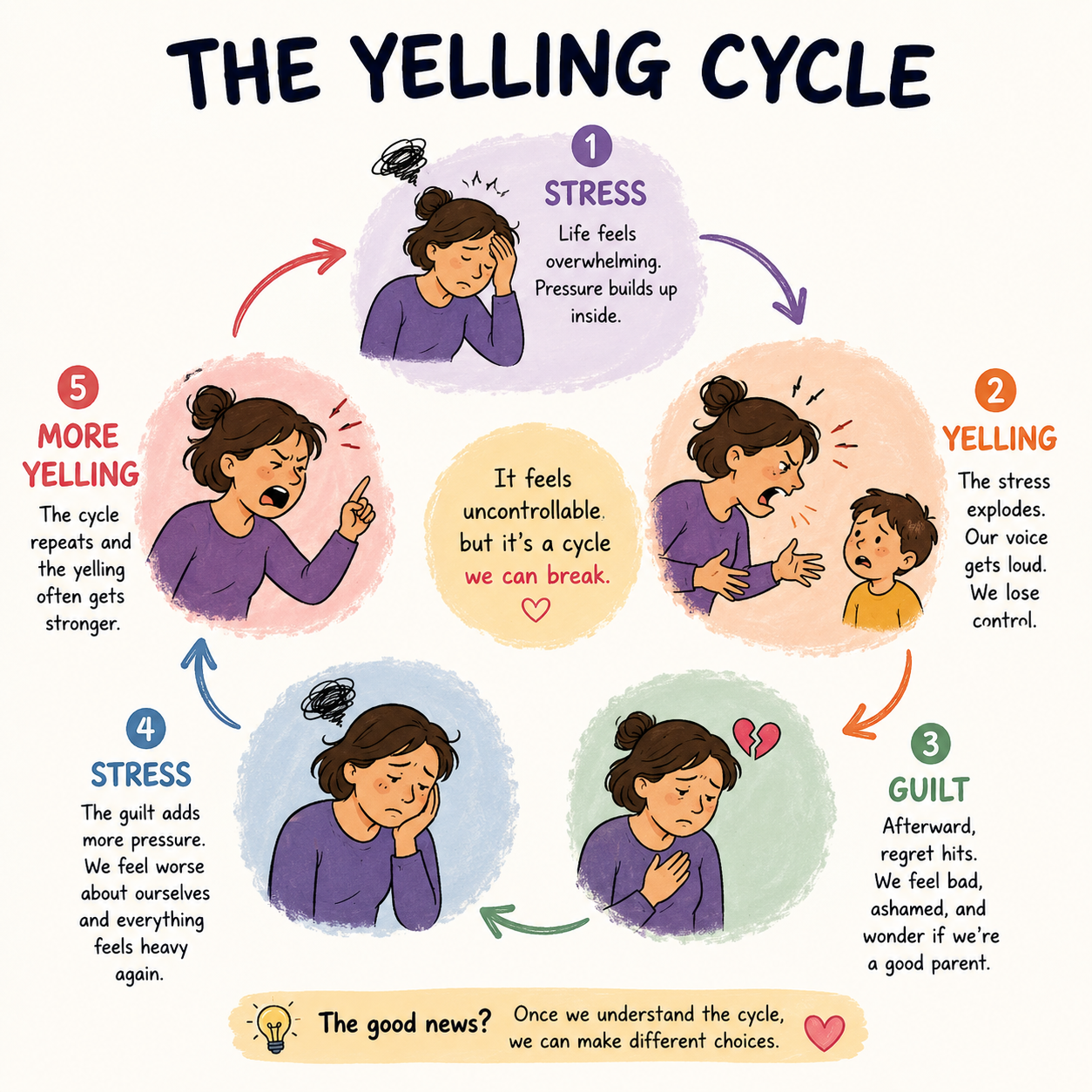
And then something unfortunate happens.
The guilt creates more stress.
The stress creates more yelling.
The cycle repeats. Understanding this cycle is the first step toward breaking it.
Part 4: What to do instead of yelling
Many parenting articles accidentally create the impression that good parents never get frustrated. That is not true.
Healthy parenting is not the absence of anger. Healthy parenting is learning what to do with anger.
You do not need to eliminate frustration. You need alternatives.
Let’s look at some.
15 Alternatives that work better than yelling
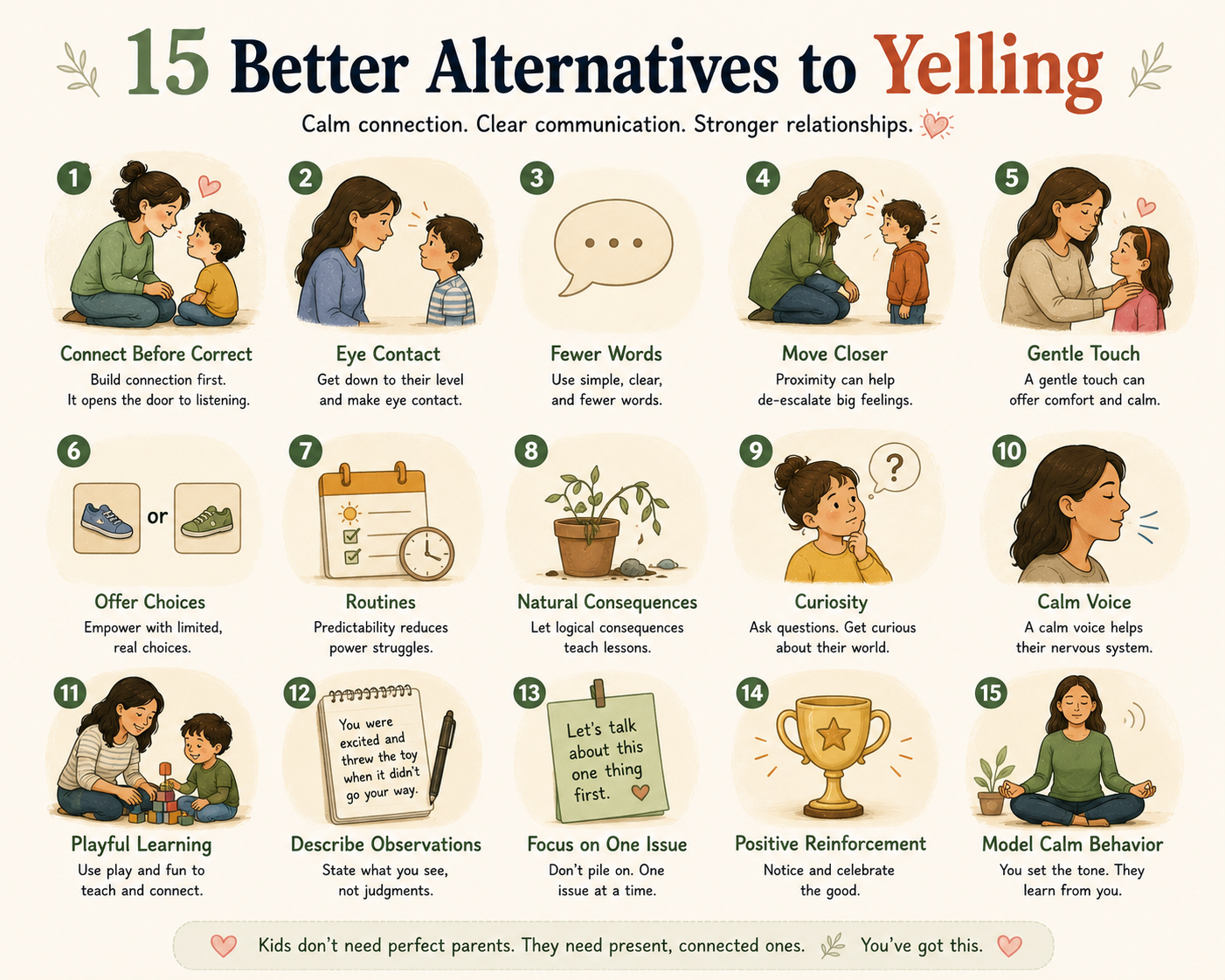
1. Connect Before Correct
Children cooperate more with people they feel connected to.
Before giving instructions:
- Make eye contact
- Use their name
- Get physically close
2. Use Fewer Words
Parents often give TED Talks, children mostly need a tweet.
Instead of: “How many times have I told you to clean your room?”
Try: “Arsh… (Pause) Room (Pause) Ten minutes (eye contacts, hand on the head or back)”
3. Move Closer
Many instructions are given from another room. Children are not Wi-Fi devices, they are bluetooth.(Now who yelled, “yes because they don’t brush well??”)
Go to them.
4. Touch the Shoulder
Gentle physical connection often gains attention faster than volume.
5. Offer Choices
Instead of: “Do your homework now.”
Try: “Homework before snack or after snack?”
Children like autonomy.
Adults do too.
6. Create Routines
Routines reduce arguments. Fewer the decisions, fewer the battles.
7. Use Natural Consequences
Not punishment. Reality.
For example: Waking-up late means missing horse-riding because I won’t be standing there 1 more hour so that you get a chance in the next slot.
8. Ask Questions
Instead of: “Why are you so careless?”
Try: “What happened here?”
Questions invite thinking.
Accusations invite defence.
9. Be Curious
Curiosity is often more useful than judgment.
Judgment
Teacher: “Why are you talking? Are you coming to the class to talk with others? You never pay attention. You will remain dumb.”
Student:
Stop listening completely.
Curiosity
Teacher: “You seem distracted today. Is something on your mind?”
10. Lower Your Voice
A whisper often attracts more attention than shouting.
Children expect yelling.
They do not expect calm.
11. Use Play
Can the socks become rockets?
Can toys race into the toy box?
Can homework begin with a challenge?
Creative Play often succeeds where power struggles fail.
12. Describe What You See
“I see books still on the floor.”
instead of
“You’re always messy.”
13. Focus on One Thing
Avoid: “And another thing…”
Nobody enjoys surprise bonus lectures.
14. Notice What Is Going Well
Children often repeat behaviors that receive attention and appreciation.
15. Model What You Want
Children learn more from what we do than what we say.
Calm Voices, Calmer Kids
Psychologist Dr. Dan Siegel often talks about co-regulation.
In simple language:
Children borrow calm from adults. Your nervous system influences theirs. Your calm does not guarantee cooperation. But it increases the chances. Think of yourself as the thermostat rather than the thermometer. A thermometer reflects the environment.
A thermostat influences it.
Part 5: 25 Tips, activities and easy exercises to stop yelling
In-the-moment tools
1. Take three slow breaths.
2. Drink water.
3. Count backwards from 10.
4. Sit down before speaking.
5. Lower your voice intentionally.
6. Step away briefly.
7. Relax your shoulders.
8. Unclench your jaw.
9. Put a hand on your chest.
10. Ask: “What is the real problem here?”
Daily habits
11. Sleep more.
12. Eat regularly.
13. Exercise.
14. Reduce unnecessary commitments.
15. Share responsibilities.
16. Create routines.
17. Schedule downtime.
Relationship builders
18. Ten minutes of one-on-one play daily.
19. Family meals.
20. Read together.
21. Laugh together.
22. Spend device-free time together.
Reflection exercises
23. Keep a trigger journal.
24. Celebrate small improvements.
25. Practice self-compassion.
Quick Quiz: What Type of Yeller Are You?
When stressed, do you usually:
A. Explode immediately
B. Stay calm for a long time and then explode
C. Use sarcasm
D. Become silent and distant
E. Raise your voice repeatedly
Knowing your pattern helps you interrupt it.
Part 6: When the damage is already done
How To Repair After Yelling At Your Child
Good relationships are not built because mistakes never happen.
They are built because repairs happen.
This is one of the most important ideas in modern attachment research.
Children do not need perfect adults. They need adults who repair.
Step 1: Calm Yourself First
Do not apologize while still angry.
Wait.
Breathe.
Regulate.
Step 2: Take Responsibility
Say: “I shouldn’t have shouted.”
Not: “I’m sorry but you made me angry.”
The word “but” often cancels the apology.
Step 3: Validate Feelings
Try: “That probably felt scary.”
or
“I imagine that upset you.”
Step 4: Reconnect
- Hug
- Sit together
- Walk together
- Play together
Connection helps healing.
Step 5: Problem-Solve Together
Ask: “What can we both do differently next time?”
Now the conversation becomes collaborative.
What A Good Apology Sounds Like
For Young Children
“I got too loud. That wasn’t okay. I’m sorry.”
For Older Children
“I was frustrated, but yelling wasn’t the right way to handle it.”
For Teenagers
“I want to talk about what happened. I lost my temper and I’d like to do better.”
Can Children Recover From Being Yelled At?
Absolutely.
Relationships are surprisingly resilient. Especially when repair happens consistently.
Research on attachment shows that healthy relationships are not perfect. They are repaired. A child who experiences occasional conflict followed by genuine repair is learning something valuable.
Part 7: When to seek more support
Sometimes yelling becomes more than an occasional problem.
Sometimes it becomes a pattern.
Signs you may need support
- Yelling every day
- Feeling out of control
- Frequent guilt
- Constant conflict
- Fearful children
- Emotional exhaustion
- Burnout
Seeking help is not failure.
It is responsibility.
Who can help?
Family members
Sometimes support starts close to home.
Friends
Trusted friends can provide perspective.
Parent groups
It helps to realize you are not alone.
Parenting coaches
Practical support and strategies.
Therapist
Especially if anger feels overwhelming or connected to deeper stress.
Teachers & schools
Teachers often see patterns and may offer useful insights.
Remember: Parents and teachers are on the same team.
Conclusion
Every parent loses their temper and every teacher becomes frustrated. So forgive yourself.
The goal is not perfection but awareness, learning and repair.
Children do not need adults who never get angry. They need adults who understand their anger, manage it responsibly, and know how to reconnect when things go wrong.
A calm voice will not solve every problem. But it creates something powerful. A child who feels safe enough to listen. A relationship strong enough to recover.
And a home—or classroom—where mistakes become opportunities for growth rather than reasons for fear.
That is not easy.
But good news – it is possible.