Animal senses: how nature inspires sensors of the robots
A thousand year old palace in the center of the forest. It’s a dark night and you are walking alone (btw would you?😜). It’s impossible to see anything. You don’t know what you are crushing with your feet or where you might bang your head.
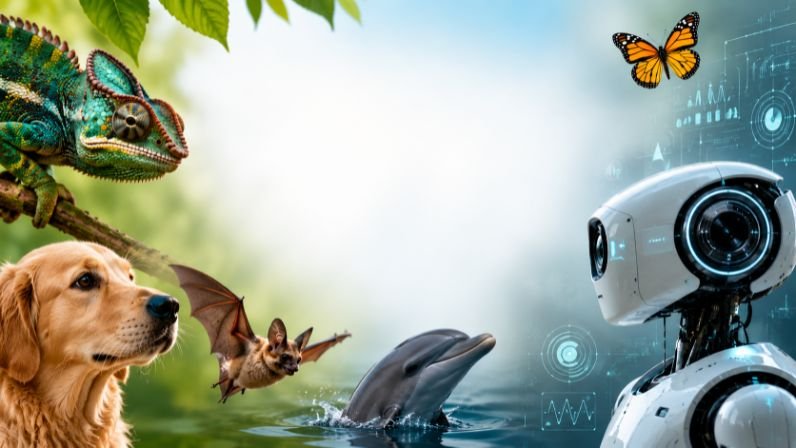
But somewhere nearby, a bat is flying around, finding its way, avoiding obstacles and even hunting for insects.
You have built a DIY robot using a Havi controller. What are the chances you have carried that with you? 😄 The robot is moving around avoiding every single obstacle on the way.
How do bats and robots do that?
They can’t see either. They use a “sensor” to send out sound waves and measure the echoes that bounce back.
Pretty amazing, right? This science is called “Echolocation”.
So who created the ultrasonic sensor? Some engineer or mother nature? Nature, of course. Engineers and scientists later understood the design and technique to build their devices. That’s called “Biomimicry”.
Animals, birds and insects have been sensing their surroundings for millions of years. They can detect sounds, heat, vibrations, chemicals, water movement, electricity, magnetic fields and even types of light that humans cannot detect.
Let’s meet some animals, birds and insects with their very own “built-in sensors.”
Bat → Ultrasonic Sensor
A bat flying through a dark cave doesn’t need a flashlight.
It makes very high-frequency sounds and listens for the echoes that bounce back from objects. This is called echolocation. The echoes give the bat information about where objects are and help it navigate and hunt.

Dolphins too, use echolocation to locate the objects and other creatures.
Ultrasonic sensor in robots
A robot can send an ultrasonic pulse, wait for the echo and calculate how far away an object is.
So the next time a robot avoids a wall, you can think: “Hmm… that’s a little bit bat-like!”
Pit Viper → Infrared Sensor
Here’s one that sounds like a superpower.
Some snakes, including pit vipers and some pythons, have special heat-sensing pits between their eyes and nostrils.
These organs detect infrared radiation—the heat given off by warm objects. This helps the snake locate prey even when it is dark.
Infrared / thermal sensor in a robot
An electronic infrared sensor can help a robot detect nearby objects, movement or sources of infrared radiation.
So while you might need your eyes to find something in a dark room, a pit viper has a completely different trick.
Snake: “I can feel the heat.”
Robot: “I have a sensor for that.”
Fish → Water-Pressure Sensor
Fish have something humans definitely don’t have: a lateral line.
It runs along the body and contains tiny sensory structures that detect movement and pressure changes in the surrounding water. This helps fish sense nearby animals and objects, even when they can’t see them.
Flow, pressure or vibration sensor in robots
Electronic sensors can detect physical changes around a robot and turn them into signals that its controller can understand.
For example, a water-flow sensor can tell an underwater robot which way water is moving. A pressure sensor can detect changes in water pressure, while a vibration sensor can notice movement or disturbances.
Shark → Electricity Sensor
This one may be the coolest.
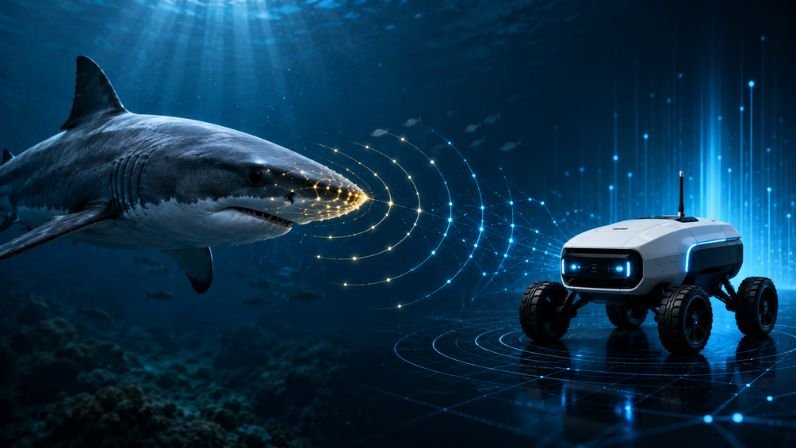
Every time an animal’s muscles work, tiny electrical signals are involved. Sharks can detect these electrical fields and locate their prey. They do this using special sensory organs called ampullae of Lorenzini, concentrated around their heads.
It’s almost like having an invisible sixth sense:
“I can’t see you… but I know you’re there.”
Electrical-field sensor in robots
The sensor detects tiny changes in an electric field and converts them into an electrical signal that a robot’s controller can understand.
A robot could use this kind of sensing to:
- Detect electrical activity nearby
- Find or locate an electrical source
- Detect changes in an electrical field
- Make decisions based on those changes
Migrating Bird → Magnetic Sensor
How does a bird travel thousands of kilometres and find its way?
Birds like falcon, Goose, Crane, and Flamingoes use several clues, including the Sun, stars, landmarks and Earth’s magnetic field. Scientists have strong evidence that Earth’s magnetic field plays an important role in the navigation of many migratory birds, although exactly how birds detect magnetic information is still being studied.
Magnetometer / electronic compass in Robots
Your phone or robot uses a magnetometer to detect magnetic field and direction.
A migrating bird doesn’t need Google Maps though.
It has a much older navigation system built into its biology.
Spider → Vibration Sensor
A spider sitting quietly on its web may look like it is doing absolutely nothing.
But its web is also a giant vibration detector.
When something touches or moves the web, vibrations travel through it. The spider can detect those vibrations and get clues about what is happening.
Vibration sensor / accelerometer in robots
A robot can use a vibration sensor to notice things such as footsteps, knocks or movement.
The spider’s web is basically a very clever natural alarm system.
Bee → UV Light Sensor
We see visible light.
But some animals see parts of the world that we cannot.
Bees can detect ultraviolet light, giving them visual information that is invisible to humans.

This is a great reminder that seeing isn’t the same for every animal.
Two creatures can look at the same flower and receive completely different information.
UV/light sensor of robots
The sensor contains a light-sensitive component that reacts when UV light falls on it. It converts the amount of UV light into an electrical signal, which the robot’s controller can read and use.
That means a robot can be programmed to do things like:
- Alert us when UV levels become high
- Measure how much UV light is present
- Compare UV levels at different places or times
- React differently to different light conditions
That’s not all, there are several other animals, birds and insects born with natural sensors. For kids, we have prepared a downloadable worksheet along with answers to match the creature with the animal. Parents, Teachers and students can download for free.
Try This With Your Students
Pick one animal and ask:
- What can this animal sense that humans cannot?
- Which part of its body acts as the sensor?
- What information does the animal get?
- Is there an electronic sensor that can do a similar job?
- What robot could you build with it?
That’s the beginning of thinking like both a biologist and a robotics engineer.
So… Are Animal Sensors and Electronic Sensors the Same?
Not really.
And that’s an important lesson.
A biological sensor is part of a living animal, bird or insect. It works together with nerves, brain and other senses.
An electronic sensor is a device that detects something and converts that information into a signal that an electronic system can use.
But the basic idea is remarkably similar:
Something happens in the environment
↓
A sensor detects it
↓
Information is sent somewhere
↓
A decision is made
↓
Something happens
That’s exactly what happens in a robot too.
Nature Has Been Engineering for a Very Long Time
Scientists and engineers often look at nature for inspiration. This idea is called biomimicry—learning from how living things solve problems.
Bats inspire ideas about sensing and sonar.
Fish inspire ideas about underwater sensing.
Birds inspire ideas about navigation.
And many other animals have abilities that engineers are still trying to understand.
So when you build a robot and plug in a sensor, remember:
You aren’t just connecting a little electronic component.
You are giving your robot a tiny new sense.
And nature has already been doing that for millions of years.
But that’s why robots can be so powerful
Nature has given a power – a sensor to creatures. But Robots can have all these senses. And that’s how it becomes a super power. And so, it’s the responsibility of the makers of the robots to use these super power well. In the benefit of all the animals, birds, insects, humans and everything natural on this earth.
You would do that, right?