Microcontrollers Made Simple – for Kids, Parents, and Teachers
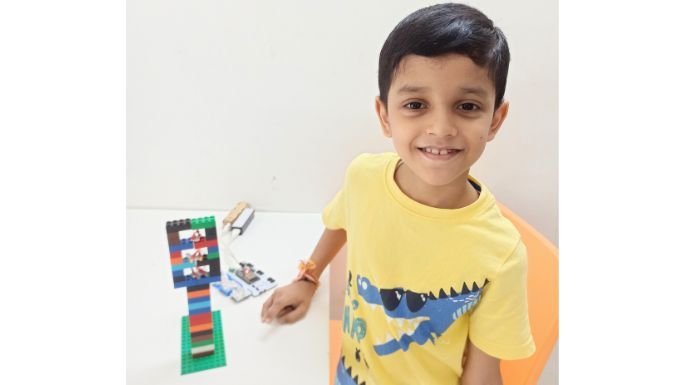
8 yo Sneha has made a traffic signal model using Havi Elements. She made the traffic signal structure using havi bricks and then used LED Element with 3 colored LEDs.
Sneha was happy and wanted to flaunt her creation to her friends.
Everyone appreciated her work but 9 yo Vaikunth kept looking at it for a few seconds and then said,
“But traffic lights don’t remain static and don’t remain ON altogether. They go ON and OFF one by one and they blink too?”
Point!
Sneha and several other kids of her age have made a static traffic signal model using Havi Elements as part of their initial days of STEAM and robotics learning. They were happy with their creations! But Vaikunth has bought a new challenge – no, not for Sneha but for her teacher, Nancy!
The bunch of curious students along with Sneha and Vaikunth went to Nancy to explain the situation.
Nancy was delighted to see the level of involvement and curiosity of the students. She was feeling like she was doing the right thing.
“Yes, these LEDs can blink just like the real traffic signal on the road. The same LED elements and LEDs you need, but you also need something extra!” Nancy told the students.
“What’s that?” Almost all of the students shouted with an extreme level of curiosity.
Jahan, can you tell them what they would need? Ms Nancy asked 14 yo Jahan – working on something in the lab.
“Havi Controller” – Jahan replied with a smile.
“What is that?” Vaikunth asked.
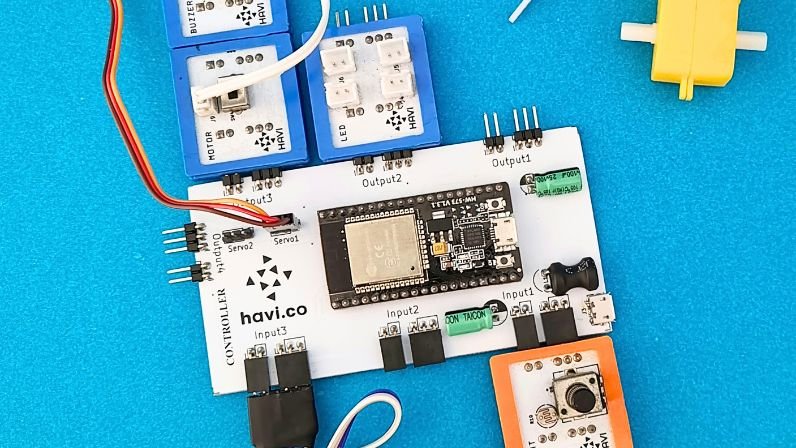
“It’s a microcontroller” Nancy replied and that triggered a series of questions for the young, curious creators.
What is a microcontroller? (explained for kids)
A microcontroller is a tiny computer chip with limited but focused computational power. It’s designed to perform and control certain tasks. It can also be programmed again and again to do a variety of tasks whenever required. That’s the simplest definition of microcontroller.
What are the examples of microcontroller
There are tens and hundreds of microcontrollers designed for a variety of purposes by different companies. Some of the most common microcontrollers used specially by kids, teenagers and college going youngsters for learning and project making are:
- Arduino Uno – it’s designed with ATmega382P chip
- Raspberry Pi Pico – built around the RP2040 chip
- ESP32/ESP8266
- Micro:bit – Made with Nordic nRF51822 and nRF52833
- Havi controller – built with a family of ESP32-wroom-32 chips from Espressif, with inbuilt bluetooth and wifi.
What is a chip?
A Microchip – another term for chip, is a collection of electronic components mainly transistors, and also resistors and capacitors. There can be several hundred thousand such very tiny transistors in a single microchip.
Okay, let me tell you in this way. You, 9 students are sitting in this robotics lab at present. We have some 10-11 chairs vacant. So, we can add those many students. But after that? What if we have 20 more?
They can come into the room but will have to stand. And then what if we have 50 more. Probably we can add them into the room but all will have to stand. And then if we have 100 more? Not possible to accommodate right?
So in that case we will have to compress you all kids (LOL). You all kids will get compressed to an extent that you can all fit in. But what if we want to accommodate 1000 students? WOW we will have to compress you even further. Guess you are getting tinier and tinier. What if 1,00,000? Further tinier. And one million? One billion kids in this room? What level of compression would happen?
The same thing happens with an IC – Integrated Circuit – another word for chip.
Microchip designers compress the transistors with a variety of highly advanced engineering and manufacturing practices, using very deep levels of physics and chemistry processes to fit more and more components in a chip. A microchip sized almost like your teeth or the nail of your pinky finger can have maybe a few millions to billions of transistors in it.
This chip, some memory like RAM and ROM, and some input output ports or pins together form a microcontroller.
Microcontroller facts for kids
“You said several thousand transistors in a single chip, how many exactly? And how come engineers fit so many transistors in single chip?” Asked Tarjav.
ARM Cortex M – the microcontroller used in smart watches has tens of millions of transistors, depending on the version.
Apple iPhone A18 chip has 15 billion transistors and A18 pro has 20 billion transistors in it.
And what’s the size of this chip containing 15 billion transistors? 90 mm²
Arduino uno board has hundreds of thousand transistors. And when you are carrying a Havi Controller, know that you are carrying a few million transistors in your pocket.
What is the best microcontroller for kids?
Kids normally use Arduino Uno and Havi Controller to learn robotics and make STEAM projects.

While Arduino is very old and well-known, Havi Controller is more powerful compared to arduino, easy to use and operate, has inbuilt Bluetooth and WiFi, and most importantly can be easily programmed with Python language.
What age is suitable for kids to learn microcontrollers?
Generally speaking, kids of age 12+ can start learning microcontrollers. It involves programming. As Havi controller uses a much easier programming language – Python, kids as young as 8–10 years can start with simple microcontroller projects like traffic lights or automatic lamps. At this age, they learn through play. Older kids (12+) can try more advanced projects including building robots, vehicles and IoT systems.
Which devices have microcontrollers?
Microcontrollers are everywhere. You find them in all devices having some level of computation or “smartness”.
- Toys and gaming consoles
- Washing machines and microwaves
- Cars and bikes
- Smartwatches and fitness bands
- TV, AC, Freeze, Cameras
What microcontrollers are used in toys?
Many smart toys already have small microcontrollers inside them! Simple toys like talking dolls, and remote cars use tiny 8 bit chips. While advanced toys like robots and drones use controllers like Arduino, ESP8266, Havi Controller and ESP32.
What is programming and how to program a microcontroller?
Programming is like giving step-by-step instructions to your computer or a microcontroller, so it knows what to do.
For example with Havi Elements LED circuit, the Red, Green and Yellow LEDs remain ON forever. But when connected with Havi controller, you give instructions like:
“Turn ON red LED → wait 5 seconds → turn it OFF.”
“Turn ON green LED → wait 5 seconds → turn it OFF.”
Do this for 5 times
“Turn ON yellow LED → wait 0.5 seconds → turn it OFF” → wait 0.5 seconds.
Microcontrollers can be programmed using programming languages like C, C++, Scratch blocks and Python.
You can program an Arduino board with C++, while Havi controller can be programmed with Python and C++ both.
What are some cool projects kids can make with Havi Controller?
It’s endless….. You can think of N number of projects that you can build using Havi controller. To give few examples:
- Maze solving robot
- Smart farm watering system
- Home automation system
- Drone
- Smart dustbin
- Basic AI projects

FAQs for parents/teachers
1. Is it safe for kids to work with microcontrollers?
Yes. Beginner kits use low-voltage (safe to touch) components.
2. Why should kids learn microcontrollers?
It builds problem-solving, logical thinking, and creativity while connecting science with real life.
3. Do kids need prior coding knowledge?
No. But it’s essential that kids’ minds are ready to understand the programming. It’s better to go through offline coding activities at a young age and then work on block based programming projects and then python programming.
4. How much time should they spend?
Even 1–2 hours a week is enough to start building fun projects and learning steadily.
That’s all about microcontrollers for kids. I hope teachers and parents will benefit from this blog post and convey the same to the students.