16 Benefits of AI in education and what schools should do to implement
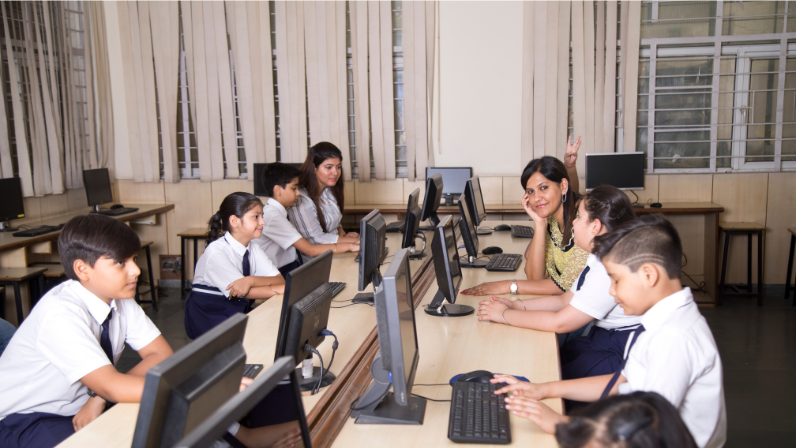
AI is sparking a renaissance in several domains, why should education be left behind? In-fact education is waiting for a total reform for a few decades now. Everyone agrees the current system, built around the Industrial age, is not suitable for the modern day, technology driven world.
AI, if used well, brings a promise to deliver the change in education we all have been waiting for quite some time.
What AI will deliver, if implemented well in education? Let’s understand the benefits first.
Benefits of AI in education
Hyper‑personalized learning
Hyper-personalized learning comes alive when AI adapts to each learner. At a Bengaluru school, teacher Ananya Rao uses an AI platform to build individual math profiles for each of her 30 students. The system generates personalized questions, tracked responses, and helps her continuously tailor each student’s learning journey for better outcomes.
Frees up time for sports, arts, and other activities
There are schools like Melbourne Girls Sports Schools that enable students with devices, and AI powered apps, all controlled and monitored closely by teachers. The technology enables students to complete their class work and subjects (maths, science and languages) in less than 3 hours. This enables students like Maya Chen to have more time for sports, arts and other activities. Maya has gained immense confidence in herself by playing basketball for a couple of hours in the last 3 months.
AI addresses learning gaps
AI addresses learning gaps by identifying exactly where students struggle. In a Pune classroom, teacher Rahul Mehta used an AI tool that analyzed test responses and homework patterns. It flagged concept-level gaps for each child and suggested targeted practice, helping slow learners catch up without holding back the rest of the class.
Understands students’ and teachers’ mental health
In a Helsinki school, counselor Sofia Lindström used an AI well-being tool that tracked mood check-ins, workload patterns, and stress signals. It alerted teachers early when students or educators showed burnout signs, enabling timely conversations, schedule adjustments, and support before problems escalated.
Enhances output of teachers
In a Toronto middle school, science teacher Priya Nair used an AI assistant to design lesson plans, experiments, and assessments in minutes. With routine preparation automated, she focused more on mentoring and hands-on activities, improving both lesson quality and student engagement.
Accurate, real-time communication between teachers, schools, parents, and students
At a Seoul international school, administrator Kim Min-joon deployed an AI communication platform that translated messages, sent instant alerts, and tracked acknowledgements. Parents, teachers, and students stayed aligned in real time, reducing confusion and missed updates.
Student safety at school and on the way
In Jakarta, school principal Siti Pratama implemented an AI safety system that monitored entry points, bus routes, and attendance patterns. The system flagged anomalies instantly, ensuring faster response times and safer commutes for students.
Learning expands beyond classrooms and schedules
In Nairobi, high-school student Aisha Mwangi used an AI learning companion that adapted lessons to her daily routine. Whether at home or on the bus, she accessed short, personalized modules, allowing learning to continue beyond fixed classrooms and timetables.
Education shifts toward independence and resilience
At a school in Kyoto, teacher Hiroshi Tanaka introduced an AI coach that encouraged students to set goals and reflect on failures. Students like Kenji learned to self-correct and persist through challenges, building independence and emotional resilience.
Teaching shifts toward curiosity, execution ability, problem-solving, and creativity
In Barcelona, educator Marta López used AI to handle factual instruction, freeing class time for open-ended challenges. Her students designed solutions to real-world problems, focusing on curiosity, execution, and creative thinking rather than rote memorization.
Hands-on, play-based, and outdoor learning becomes central
At a primary school in Cape Town, teacher Sipho Dlamini paired AI planning tools with outdoor projects. Students used play-based activities—building, testing, and observing in real environments—while AI helped document progress and reflect on learning outcomes.
Enables audio, video, project outcomes, and other assessment mediums
In Bhavnagar, teacher Upendra Barot used an AI assessment platform where students submitted audio explanations, short videos, and project builds instead of written tests. The AI evaluated understanding across formats, allowing diverse learners to express knowledge in ways that suited their strengths.
Assessment accuracy
At a school in Zurich, educator Lena Fischer relied on AI to cross-check test answers, assignments, and class participation. The system reduced human bias and inconsistencies, giving precise, data-backed evaluations that reflected true student understanding rather than exam-day performance alone.
AI automation streamlines school data and compliance
In Singapore, administrator Wei Ming implemented AI to manage attendance, reports, and regulatory submissions. Automated data validation and reminders reduced errors and paperwork, helping the school stay compliant while freeing staff from repetitive administrative tasks.
AI enables teachers to focus on mentoring and connection
In Jaipur, English teacher Neha Sharma used AI to handle grading and feedback drafts. With routine tasks automated, she spent more time mentoring students individually, building trust, and guiding them through personal and academic challenges.
Skills-focused ecosystems prepare students for dynamic work
At a vocational school in Dubai, instructor Shaily Oza integrated AI-driven skill mapping with real-world projects. Students built portfolios aligned to evolving industry needs, preparing them for adaptable careers rather than fixed job roles.
There are several direct and indirect benefits to schools, teachers, educators, students and parents, the entire ecosystem of education.
What institutions and educators should do in order to gain from AI? What should be the right AI policy? Let’s understand that.

What Schools and educators should do with AI
Use AI to improve outcomes, not to create novelty.
Adopt AI only where it measurably enhances learning, teaching effectiveness, or student well-being—not as a showcase of technology.
Make workforce readiness a mission, not a marketing claim.
Embed real-world skills, adaptability, and problem-solving into daily learning, rather than treating “AI trained” as a promotional add-on.
Start with learning problems, not AI tools
Identify real gaps in learning, teaching, or operations before choosing where AI fits.
Keep teachers in control of pedagogy
AI should assist decisions, not replace professional judgment or classroom autonomy.
Measure impact in learning gains, not engagement metrics.
Track understanding, retention, and skill transfer—not just usage or time spent.
Protect student data and dignity by default.
Minimize data collection, ensure transparency, and avoid surveillance-driven models.
Blend AI with hands-on, social, and physical learning.
Balance screen-based intelligence with play, collaboration, and real-world experience.
Continuously audit AI for bias and learning distortion.
Regularly review outputs to ensure fairness, accuracy, and pedagogical alignment.
Use AI to reduce cognitive load, not increase it.
Simplify workflows and decision-making instead of adding new layers of complexity.
Treat AI as infrastructure, not a feature.
Build it quietly into systems that serve long-term educational goals, not short-term marketing narratives.
Hope this blog will help you craft the right AI policy at your school or college. But remember that AI sparks a renaissance, not replacement, in teaching.
Need help in executing the right AI policy and practices in your institute? Contact us.